AMERICAN FAMILY FIELD (Milwaukee) – In Game 1, the Brewers defeated the defending two-time American League Cy Young Award winner. In Game 2, they exhausted the reigning World Series MVP. And as the National League Championship Series moves to Los Angeles, the Brewers have the reigning champions on the ropes with a 2-0 series lead after a 7-4 Game 2 win. Here are my takeaways: The longest plate appearance of Jake Bauers’ career lasted 7 minutes, 15 seconds, long enough for Alex Vesia to start warming up in the Dodgers’ bullpen and be warm by the time Bauers walked to first base after taking pitch No. 12 from Yoshinobu Yamamoto. The runners at first and second, who were on the move in a full count, looked exhausted. They were granted only a momentary break in the middle of the battle, when there was a mound visit to try to fix Yamamoto’s PitchCom device. Otherwise, it was a constant sprint and retreat. Bauers fouled off three four-seamers, a curveball, a cutter and a splitter from Yamamoto, who threw the kitchen sink at the Brewers’ first baseman hoping he would eventually swing and miss. He did not. After a constant barrage of foul balls to the left and the right, Bauers finally took a curveball in the dirt to accept his base on balls, complete with a well-deserved bat flip. “It was a blast, honestly,” Bauers said. “Any time you can get that locked in doiong anything, it’s, to me, one of the most enjoyable experiences I think a human being can have.” Yamamoto had built a reputation for dominating on this October stage, where last year he fired a complete game in his lone start against the Brewers in Game 2 of last year’s NLCS. That was the first of five straight playoff appearances in which Yamamoto allowed no more than one run, a streak that ended Monday at American Family Field. The Dodgers led 2-1 after the two-out walk to Bauers to load the bases. They had a southpaw in Vesia warming, but they also had their reigning World Series MVP on the mound as lefty Christian Yelich stepped to the plate. The Brewers’ captain was not in the lineup for Game 1 against left-hander Tarik Skubal, a move that manager Pat Murphy said might not happen again going forward. Dodgers manager Dave Roberts left Yamamoto in to face Yelich, who delivered a two-run single on a hanging curveball to put the Brewers ahead and end Yamamoto’s day at 2 2/3 innings. It was the shortest outing of Yamamoto’s postseason career and his shortest outing in any game since July 7, 2025, when he failed to escape the first inning. That start was also against the Brewers and was the last time he had fewer than five whiffs in a game until Monday, when he got just four swings and misses on his 73 pitches. “Tonight, he just didn’t have it,” Roberts said, “which is very rare.” The Dodgers had grown so accustomed to watching Yamamoto excel this time of year that it was hard for them to witness. “But he’s a human being, too,” said Mookie Betts. “I think everyone is so used to him being a robot that if he didn’t go eight innings with no hits or whatever, then it wasn’t Yamamoto. It shows that he’s a human being, and it’s playoff baseball. It’s part of it.” With Jackson Chourio’s heroics in the NL Division Series against the Padres and Brice Turang’s big swing in Game 1 of the NLCS, William Contreras’ positive contributions might have gone overlooked to start the postseason. “Whatever people think about him,” Murphy said, “he’s underrated.” After his second three-hit game of the playoffs in Game 2 of the NLCS, that should no longer be the case. Contreras homered in Game 1 of the NLDS, had three hits, including a home run, in Game 3 of the NLDS and went deep again Monday night while guiding Milwaukee’s comeback offense. He delivered a game-tying home run in the fifth inning — the fifth of his postseason career, tying him with Chourio for the most in Brewers postseason history — and then came through with the go-ahead single one inning later. “He’s the fire of our team,” Yelich said. “He just likes the moments, like the big moments, and we’ve got all the confidence in the world in him when he’s out there.” The dogged Brewers would pour it on from there, winning the bullpen battle the rest of the way. Including the postseason, the Brewers have a winning record this year when the opponent scores first. Four of their five wins this postseason have come in comeback fashion. As difficult of a time as Yamamoto was having against an unrelenting Milwaukee offense, he also didn’t get help from his catcher. In the first inning, Will Smith did not challenge what would have been strike three to Brice Turang, who then doubled in the at-bat and came around to score the game-tying run. In the third inning, which Yamamoto failed to finish, it happened again. The Brewers had one out and a runner on second base when a full-count cutter from Yamamoto to Turang caught the outer edge of the plate. It was called a ball. Yamamoto tentatively tapped his head, almost as if to try to convince Smith to challenge it. He did not. “I thought about it,” Yamamoto said through a translator. “But that was too fine a line on the strike zone, so I just didn’t know.” Smith said he didn’t want to burn a challenge that early in the game on a pitch that could have gone either way. Ultimately, no challenge was granted, and Turang would come around to score again after Bauers’ marathon plate appearance. After the Dodgers’ first game of the playoffs, center fielder Andy Pages had his ABS privileges taken away after a bad use of one in Game 1 of the NLDS. On Monday, the Dodgers’ unwillingness to challenge early came back to bite them and played a role in Yamamoto’s early departure. The Brewers’ bullpen entered Monday night with a 0.38 ERA this postseason. That was before their latest act of dominance. After Edman reached on Henderson’s error in the fifth inning, the Dodgers did not get another baserunner all night. They went 15 up, 15 down against the Brewers’ indomitable bullpen, one night after mustering just two hits over 4 2/3 scoreless innings against Milwaukee’s relievers in Game 1. “They all throw 100 from different angles,” said Freddie Freeman, explaining what makes them so difficult. The five perfect innings from the bullpen Monday night were the most by a relief unit ever in a postseason game. In 28 2/3 innings this postseason, Milwaukee’s bullpen has allowed just one run. The Dodgers entered Game 2 with a different game plan against Logan Henderson than they had the night before against Jacob Misiorowski. In Game 1, they were hoping to let the ball get deep in the zone, foul off pitches and make Misiorowski work, which they did. “To think you’re going to catch him out front and pull it in the air is bananas,” Roberts said. Against Henderson, though, power was the plan. The Dodgers hoped to catch the ball out front, “take some shots,” according to Roberts, and feature more of their power in Game 2. Only, it did not play out that way for a Dodgers team that still hasn’t homered in the series. Henderson’s low-release fastball creates a rising effect, one that clearly played tricks on the Dodgers early on. Through two innings, the Dodgers had already whiffed five times on their 10 swings against Henderson’s fastball — the same number of times they swung and missed all of Game 1 against Misiorowski’s heater. But while they couldn’t capitalize by slugging Henderson, they found another way to pressure the standout rookie. Henderson didn’t look rattled while throwing to home plate. Fielding his position was another story. And he wasn’t alone. The Brewers’ typically sound defense made multiple blunders in the third inning, which began with a Tommy Edman single. Edman was nearly erased one batter later when Mookie Betts drilled a one-hopper to shortstop, but rookie Cooper Pratt, who had three errors in the NLDS — the most of any player this postseason — couldn’t handle it. Instead of another double play for the Dodgers — who grounded into three of them in Game 1 — it was two on, no out. After a spectacular catch from Sal Frelick on a deep drive from Freeman, Henderson then tried to pick behind Betts at first base with runners at the corners and threw the ball away, allowing a go-ahead run to score. It wasn’t the plan, but small ball was the Dodgers’ only hope Monday night. After the Brewers knocked out Yamamoto in the bottom of the frame, another Henderson error followed in a go-ahead fifth for the Dodgers. Kyle Tucker doubled to start the frame, and Edman followed with a sacrifice bunt. Henderson airmailed the throw, allowing Tucker to score a game-tying run, ending Henderson’s night. Only two of Henderson’s four runs allowed were earned, but it was the first time all year he surrendered more than three runs in a start. Ultimately, it would not matter. 5 ½. What’s Next? Of the 27 teams to go up 2-0 in the NLCS, regardless of series length, 23 have won the pennant. Of the 18 clubs who have carried a 2-0 advantage into Game 3 of the NLCS in its current best-of-seven format, 15 have advanced to the World Series. The Dodgers clearly have their work cut out if they want to three-peat, but they’ll send another former Cy Young winner to the mound for Game 3 in Blake Snell. “I know Blake has a bad taste in his mouth from that last outing against the Braves,” Roberts said. “So you’re going to see a locked-in, focused Snell. On the other side of things, we’ve got to support him offensively too.”
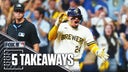
Crew Puts The Dodgers On The Ropes: 5 Takeaways From The Brewers’ NLCS Game 2 Win
Oct 12, 2026 | 8:30 PM